Retrieve logs
As with any software, sometimes things go wrong: a query fails, the server crashes, or the web UI misbehaves. When that happens, the logs record what went wrong, so you can find the root cause. This guide shows you how to retrieve Deephaven's logs and share them when you ask for help.
Deephaven produces two kinds of logs:
- Server logs: read them in the Log panel or the server container's output, copy out JVM crash files, and enable debug logging for more detail.
- Web UI logs: review the Command History panel, export support logs, and read the browser console.
Server logs
The commands in this section use Docker. If you build and run Deephaven from source with Gradle, the server prints the same log to the terminal where you started it.
Log panel
The Log panel in the web UI shows the server's log as it runs, without the need for a terminal or Docker command. When you open it, the panel shows the most recent messages the server has kept in memory and then adds new ones as they arrive. Older messages drop off, so open the panel soon after the problem occurs.
To open the panel, click the Log tab next to the Console tab. Navigate the GUI shows where the tab sits in the default layout.
By default, the panel shows only STDOUT, STDERR, WARN, ERROR, and FATAL messages. To see INFO or DEBUG messages too, click the gear (Log Settings) button at the top right of the Log panel and select them under Display Log Levels.
The panel needs a running server and holds only recent messages. When the server has stopped, or you need the full log, use docker logs.
Retrieve Docker container logs
If you start Deephaven in detached mode, with docker compose up -d or docker run -d, the server's output doesn't appear in your terminal. To see it, use the docker logs command. The command works for any container, whether it runs detached or in the foreground, and whether it's running or stopped.
Replace <CONTAINER> with the name of your server container:
Note
If you don't know the name of your container, run docker ps -a. It lists all containers, including stopped ones:
Redirect the logs to a file so you can search them. The server prints its log to standard output, and the JVM prints some startup messages to standard error, so redirect both:
If you start a container with --rm, as the Quickstart does, Docker removes it as soon as it stops. The container's logs and any crash file go with it. To keep them after the server stops, start the container without --rm.
Retrieve a JVM crash file
When the JVM itself crashes, for example with a segmentation fault (a SIGSEGV signal):
- The server process stops.
- The JVM writes a crash report file named
hs_err_pid<PID>.log, where<PID>is the JVM's process ID. - The server log gives the file's full path on the line after
# An error report file with more information is saved as:.
In the Deephaven Docker images, the JVM writes the file to /hs_err_pid1.log. If you run the container with an init process (docker run --init or init: true in Docker Compose), the process ID differs, so use the path from the server log.
Use docker cp to copy the file to your local machine. The container doesn't need to be running, but it must still exist, so copy the file before you run docker compose down or docker rm.
If you started the container with --rm, the crash file is already gone; see Retrieve Docker container logs.
Replace <CONTAINER> with the name of your server container, and change the path if the server log gives a different one:
Enable debug logging
You can fine-tune how much detail the server logs. By default, the server logs messages at the INFO level and above. For more detail, switch to the logback-debug.xml configuration file for Logback, the server's logging framework. This file logs at the DEBUG level.
To turn it on, add -Dlogback.configurationFile=logback-debug.xml to the START_OPTS environment variable, which passes JVM options to the server. For more about START_OPTS, see Modify the deployment.
Both Docker methods below create a new server container, which deletes the old container's logs and any crash file in it. If the server crashed, first save its logs and copy its crash file.
In docker-compose.yml, add the option to the existing START_OPTS line:
Then run docker compose up -d from the directory that holds docker-compose.yml. Docker Compose recreates the container with the new setting.
Without Docker Compose, pass the option to docker create with --env:
- Find where your existing container keeps its
/datadirectory, which holds your notebooks and other saved files. Rundocker inspect --format '{{json .Mounts}}' <CONTAINER>, and find the entry whoseDestinationis/data. Note itsSourceif it's a directory on your machine, or itsNameif it's a Docker volume. The image always stores/datain a volume, even if you never mounted one, so a new container that doesn't mount it starts with an empty/datadirectory. - Remove your existing server container with
docker rm -f <CONTAINER>. This command keeps the container's volumes. - Create and start a new container named
deephavenwith the commands below. Replace<DATA>with theSourceorNamefrom step 1. Add every other option you used for the original container, such as other-vvolume mounts andSTART_OPTSvalues like-Dauthentication.psk. Otherwise, the new container starts without them.
If you build and run Deephaven from source, set the variable when you start the server:
The extra DEBUG messages appear in the same server log, so retrieve them with docker logs, or read them in your terminal if you built from source. To see them in the Log panel, select DEBUG under Display Log Levels.
Web UI logs
Command history
Deephaven keeps a record of the commands you've run in the console, how long each one took, and whether it produced an error. The Command History panel shows this information, and you can search it. Navigate the GUI shows where the panel sits in the default layout.

Hover over a command to see its details.
The command in the image below was successful and took 1.24 seconds.
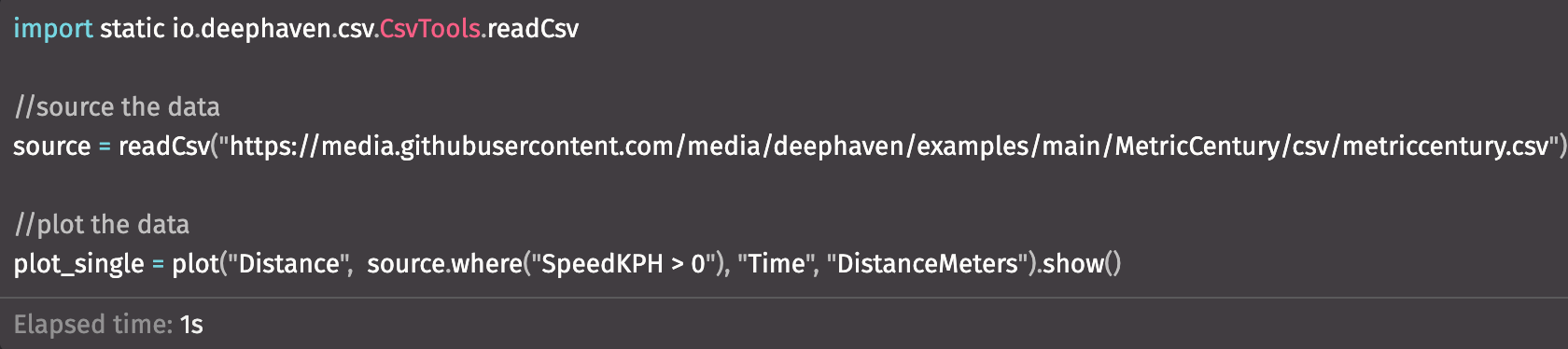
The command in the next image, however, resulted in an error after three seconds.

The error message gives an ID. Search the server log for that ID to find the full error.
Export support logs
To share your logs with other Deephaven users on GitHub Discussions or Slack, open User Settings and click Export Logs.
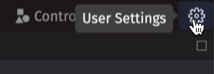
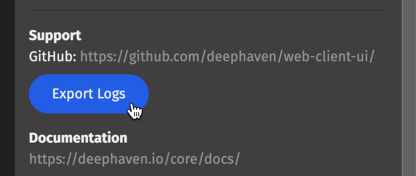
Export Logs downloads a zip file that holds the web UI's browser logs and the current state of the application. It doesn't include the server log, so attach that separately with docker logs.
View the browser console
If the Deephaven web UI misbehaves, your browser's console logs can help you diagnose the problem. For most reports, Export Logs is enough. Use the browser console when you need the raw console output or extra detail.
To access browser logs in Chrome, click the three-dot menu at the top right of the browser window and choose More tools > Developer tools. This opens the Chrome DevTools panel.
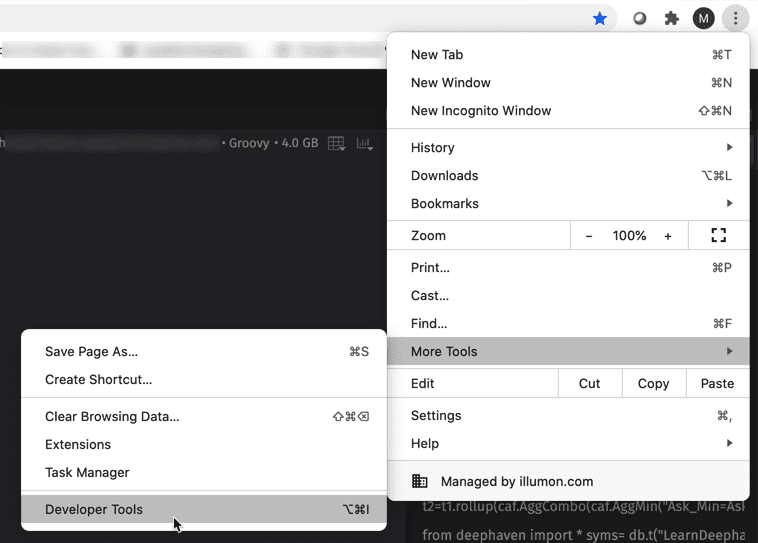
Click the Console tab. The browser logs messages here, including errors and warnings.
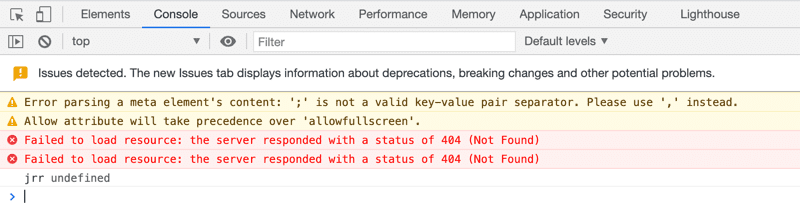
In the Default levels drop-down next to the Filter field, select every level: Verbose, Info, Warnings, and Errors. We recommend this so that no message is hidden:
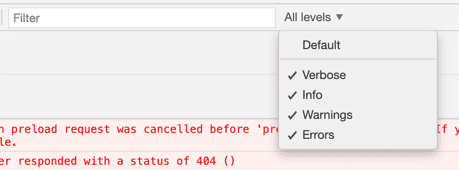
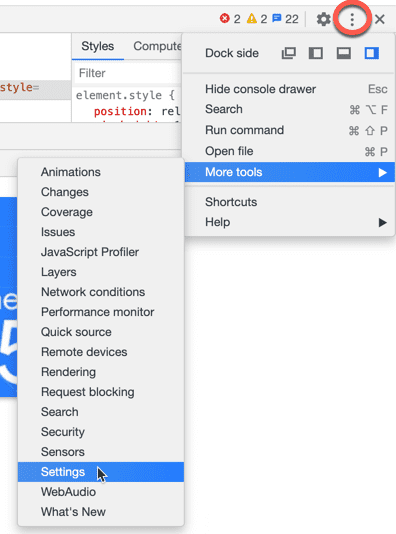
To capture more detailed information, change the DevTools console settings. In DevTools, click Settings (the gear icon) in the top action bar, or press F1:
Under Console, you can choose options such as Log XMLHttpRequests and Show timestamps:
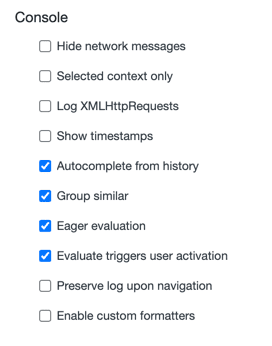
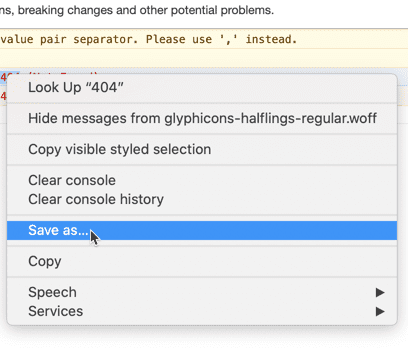
To share the raw console output, right-click within the Console and choose Save as. The saved file includes the extra messages from Log XMLHttpRequests.
Get more help
Ask questions in our GitHub Discussions forum or in our Community Slack. Attach the logs you collected with the steps above to help others find the cause.
Warning
Server logs can contain credentials. With pre-shared key authentication, the server logs its key and a login URL that includes the key (?psk=) when it starts. Remove these lines, and any other secrets, before you share a log publicly.